

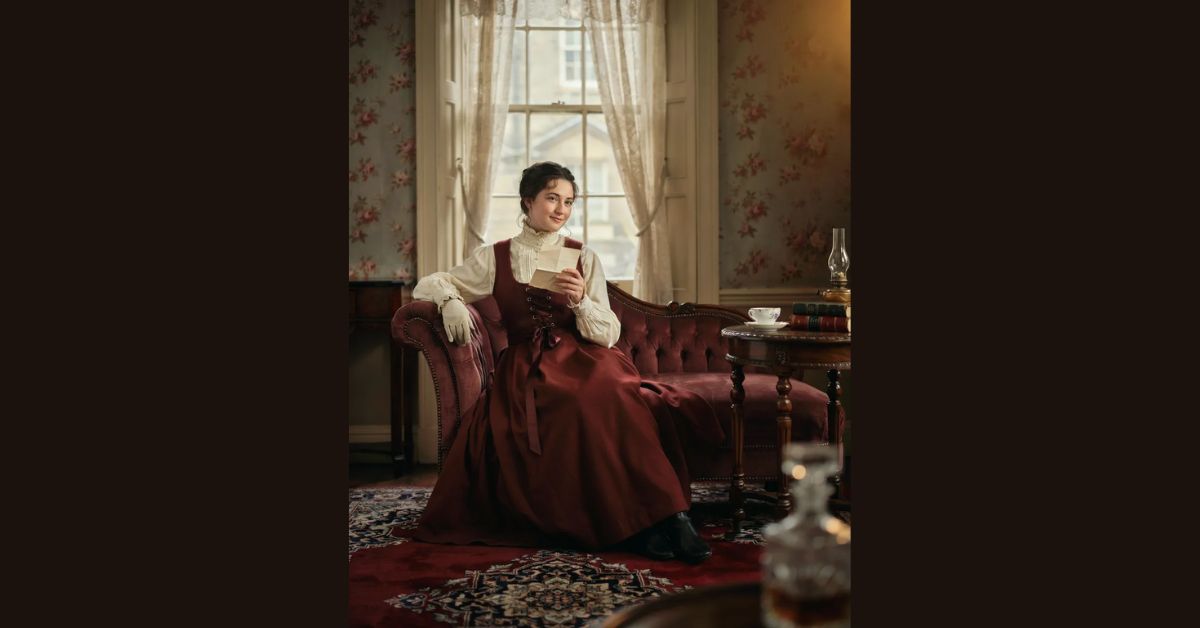
Imagine walking through the cobblestone streets of London in 1875. Every woman you pass is wearing a structured silhouette that narrows at the waist before flowing outward in layers of silk, taffeta, and velvet. Every man carries himself in a tailored frock coat that signals his rank before a single word is spoken. In the Victorian Age, fashion was never merely clothing. It was a complete system of communication, a social contract stitched together with thread and ambition.
The Victorian era, spanning Queen Victoria’s reign from 1837 to 1901, produced some of the most elaborate, expressive, and symbolically loaded garments in the history of human dress. Historians estimate that a wealthy Victorian woman could own upwards of thirty distinct garment categories, each assigned to specific times of day, social occasions, and levels of mourning. Understanding this era means understanding that dressing elegantly was considered both a moral responsibility and an art form. This article explores the key developments of Fashion Victorian Age, the cultural forces that shaped it, the fabrics and silhouettes that defined it, and why its influence on elegance and style remains visible even today.
The Social Architecture of Victorian Dress
Victorian fashion cannot be separated from the rigid class structure of the period. Clothing functioned as an immediate visual marker of social standing, occupation, marital status, and moral character. The upper classes spent enormous sums on garments they might wear only once or twice, while the working classes made do with practical, durable fabrics designed to withstand labor.
The middle class, growing rapidly as industrialization transformed Britain and Europe, used fashion as one of the primary tools of upward social mobility. Dressing correctly according to the occasion was treated with the same seriousness as business conduct or religious observance. A woman who appeared in public in an unsuitable gown risked social censure, while a man whose coat was poorly cut or whose cravat was improperly tied could find his professional reputation quietly undermined. Etiquette manuals of the period devoted entire chapters to the correct dress for morning calls, afternoon visiting, dinner parties, balls, church attendance, and travel. Fashion historians note that by the 1880s, there were at least seven distinct dress categories a middle-class woman was expected to maintain.
The Evolution of the Victorian Silhouette
One of the most fascinating aspects of Victorian fashion is how dramatically the ideal female silhouette changed across six decades. The era did not have a single aesthetic; instead, it moved through distinct phases, each driven by changing tastes, new technologies, and shifting ideals of femininity.
The early Victorian period, roughly 1837 to 1860, was defined by the romantic silhouette inherited from the 1830s. Wide skirts were supported by multiple petticoats, creating a bell-shaped form that emphasized a small, tightly corseted waist. Sleeves were large at the shoulder and tapered toward the wrist. The overall effect was soft, rounded, and domestic, reflecting the era’s idealization of women as gentle, nurturing figures at the center of family life.
The crinoline era arrived in the late 1850s and transformed Victorian fashion spectacularly. The invention of the cage crinoline, a lightweight frame made from hoops of steel or whalebone, allowed skirts to reach extraordinary widths without the weight of layers of petticoats. Skirts at the height of the crinoline fashion measured up to eighteen feet in circumference at the hem. The cage crinoline became one of the most widely adopted fashion technologies of the nineteenth century, crossing class boundaries in ways that few garments did. Factory workers and ladies of the manor alike wore their own versions of the wide-skirted silhouette.
By the late 1860s and through the 1870s, the crinoline gave way to the bustle. Skirts became flatter at the front and dramatically extended at the back, creating the distinctive shelf-like protrusion at the rear that modern audiences find so visually striking. The bustle went through two distinct phases, disappearing briefly in the early 1880s before returning in an even more exaggerated form between approximately 1883 and 1889. This second bustle was sharper and more architectural than the first, creating a nearly horizontal shelf of fabric at the back of the skirt.
The final decade of the Victorian era, the 1890s, brought what fashion historians often call the New Woman silhouette. Skirts became straighter and more practical, while sleeves ballooned at the shoulder in the leg-of-mutton style before tapering dramatically to a tight wrist. This silhouette, bold and slightly more active in its proportions, reflected the early stirrings of the women’s rights movement and changing attitudes toward female physical activity and independence.
Corsetry and the Construction of Victorian Elegance
No discussion of Victorian fashion is complete without addressing the corset, the foundational undergarment that shaped every visible aspect of women’s dress during this period. The Victorian corset was a heavily structured garment made from cotton, silk, or satin, reinforced with bones of whalebone, cane, or later, steel. It was designed to compress the waist, lift the bust, and flatten the abdomen, creating the hourglass form that Victorian aesthetics demanded.
The corset has been the subject of significant historical debate. For much of the twentieth century, it was portrayed as a purely oppressive garment imposed on women against their will. More recent scholarship has complicated this picture considerably. Dress historians such as Valerie Steele have demonstrated through surviving examples and medical records that truly extreme tight-lacing, the practice of reducing the waist to extraordinarily small measurements, was far less common than popular mythology suggests. The majority of Victorian women corseted for support, posture, and shape rather than for waist measurements approaching the impossibly small figures found in caricatures and sensational journalism of the period. The average corseted waist in the Victorian period was between twenty and twenty-three inches, reduced by approximately two to four inches from the natural measurement.
What the corset undeniably did was require women to carry themselves in a particular way. Upright posture, controlled movement, and a certain deliberate grace were both required by the garment and admired as social virtues. The physical discipline of corsetry was deeply intertwined with Victorian ideas about self-control, propriety, and the cultivation of elegance as a form of character.
Fabrics, Color, and the Victorian Palette
The Victorian era coincided with one of the most revolutionary periods in textile history. The Industrial Revolution transformed fabric production, making machine-woven cloth available at prices that brought fashionable dress within reach of a broader population than ever before. At the same time, synthetic dyes, beginning with William Perkin’s discovery of mauveine in 1856, introduced a palette of vivid, stable colors that had been previously impossible or prohibitively expensive to achieve.
Silk remained the prestige fabric of the Victorian era, used in its many forms for every occasion from formal court dress to delicate evening wear. Silk taffeta, with its crisp rustle known as the frou-frou, was enormously fashionable in the 1850s and 1860s. Silk velvet, heavy and lustrous, appeared in evening and winter dress throughout the era. Lighter silks, including satin and faille, were essential for formal occasions. The sound of silk moving was considered part of the aesthetic experience of fashionable dress, and dressmakers paid careful attention to the acoustic as well as the visual qualities of their materials.
Wool appeared in its finest form as cashmere, used for the Kashmir shawls that were among the most coveted status objects of the early and middle Victorian period. A genuine Kashmir shawl, hand-woven in India, could cost the equivalent of several months of a middle-class household’s income. The demand for these shawls was so intense that the weaving industry in Paisley, Scotland developed affordable machine-made imitations that gave their name to the enduring paisley pattern.
The introduction of synthetic dyes in the second half of the Victorian era created a revolution in color. Before Perkin’s mauve, bright purple had been restricted to royalty and the very wealthy because the natural dyes required to produce it were extremely rare and expensive. Synthetic dyes rapidly made vivid purples, magentas, bright greens, and electric blues available to the middle classes. Fashion historians note that the color choices of the 1860s and 1870s were often startlingly bright by modern standards, reflecting the excitement with which these new hues were received.
Men’s Victorian Fashion and the Art of Understated Elegance
While women’s Victorian fashion tends to dominate popular imagination, men’s dress in this period underwent its own sophisticated evolution and remains deeply influential on modern formal wear. The Victorian era saw the gradual establishment of the dark business suit as the default garment of professional and public life for men, a convention that has proved extraordinarily durable.
The frock coat, a knee-length garment cut to fit closely at the chest and waist before flaring gently over the hips, was the standard formal coat of the Victorian period for most of the era. By the 1880s, the morning coat, cut away at the front and tapering to tails at the back, began to challenge the frock coat for formal daywear. The lounge suit, a matching jacket and trousers in the same fabric, emerged in the 1860s as acceptable dress for informal occasions and gradually gained respectability across the social spectrum.
The Victorian gentleman’s wardrobe placed enormous emphasis on quality of tailoring and subtlety of detail. Savile Row in London established itself during this period as the center of bespoke tailoring, and its influence shaped men’s formal dress internationally. The principle that a well-dressed man should be distinguished by the quality of his construction rather than the showiness of his decoration remains central to classic menswear philosophy today.
The Language of Mourning Dress
One uniquely Victorian aspect of fashion that reveals the depth of the era’s relationship between clothing and social obligation was the elaborate system of mourning dress. Victorian mourning codes required specific garments, fabrics, and colors for different periods and degrees of grief, and failure to observe them was considered a serious social failure.
Full mourning, the most intense phase following the death of an immediate family member, required women to dress entirely in matte black fabric, specifically paramatta or lustreless crepe, avoiding any shiny surface that might suggest inappropriate cheer. Jewelry was restricted to jet or hair mourning pieces. This phase could last up to two years for a widow. Half mourning, the gradual transition out of deep grief, permitted grey, lavender, and eventually purple, as well as the introduction of shiny black fabrics. The transition to colors was carefully staged and socially monitored.
Queen Victoria herself became the most powerful symbol of Victorian mourning culture following the death of Prince Albert in 1861. She wore black for the remaining forty years of her life, and her visible grief shaped the national culture of mourning in ways that went far beyond fashion. The mourning industry, including the specialist mourning warehouses that supplied complete wardrobes for newly bereaved families, was a significant sector of the Victorian textile economy.
The Legacy of Victorian Elegance in Modern Fashion
The Victorian era ended more than a century ago, yet its influence on contemporary ideas about elegance, formality, and dress continues to surface in ways both direct and subtle. The corset has returned repeatedly as both a fashion garment and a sculptural element in high fashion, most dramatically in the work of designers like Vivienne Westwood and Alexander McQueen, who explicitly engaged with Victorian dress as a source of formal innovation.
The tailored suit, both men’s and women’s, owes its fundamental structure to Victorian tailoring traditions. The wedding dress convention of white or ivory, widely attributed to Queen Victoria’s choice to wear white at her 1840 marriage to Prince Albert rather than the gold or silver traditionally favored by royalty, remains the global standard for bridal wear nearly two hundred years later. The bustle silhouette, with its emphasis on the rear profile and dramatic train, has been revisited repeatedly by couturiers from Charles James in the mid-twentieth century to modern designers working in the tradition of sculptural fashion.
More broadly, the Victorian insistence that dressing well was a form of respect for others and a reflection of one’s inner character contributed to an enduring cultural idea about elegance as something more than superficial. The art of dressing elegantly, as the Victorians understood it, required knowledge, effort, attention, and a genuine engagement with the social world. It demanded that clothing be chosen thoughtfully, worn correctly, and maintained with care. That philosophy, stripped of its more rigid social enforcement, remains one of the more enduring contributions of Victorian fashion culture to the way modern people think about personal style.
Conclusion
Victorian fashion was one of the most complex, expressive, and socially meaningful systems of dress in human history. Across six decades of change, from the romantic bell-shaped skirts of the 1840s to the assertive leg-of-mutton sleeves of the 1890s, Victorian dress reflected and shaped the society that produced it. It was driven by industrial innovation, social aspiration, moral conviction, and genuine aesthetic ambition. The art of dressing elegantly in the Victorian Age meant understanding fabric and silhouette, observing social codes with precision, and presenting oneself to the world as a person of character, taste, and care. Those principles, at their core, are not so different from what thoughtful dressing still means today.