

The first time I experienced a procurement panic, I was watching a spreadsheet on Excel all night long because a pharmaceutical batch worth millions of dollars was stalled in the cleanroom. I remember very well this working scenario with a very important pharmaceutical company that depended on only one European supplier of high-purity solvents for HPLC. Suddenly, a petrochemical incident in the supplier’s upstream production closed the supply of the product, which was the global freeze of co-products. The supplier phoned us. A minimum of eight weeks of product unavailability.
We were facing huge penalty fines, drug supply disruption plans, and complete loss of distribution channels. During the rush to keep the processes going, the technical guys suggested a substitute that they had been working with during a test run. They suggested the South Asia region. It was a real moment of revelation. We only found a stick-on-bandaid; instead, we came upon a thoroughly changed, deeply advanced production system that totally transformed our long-term sourcing strategy.
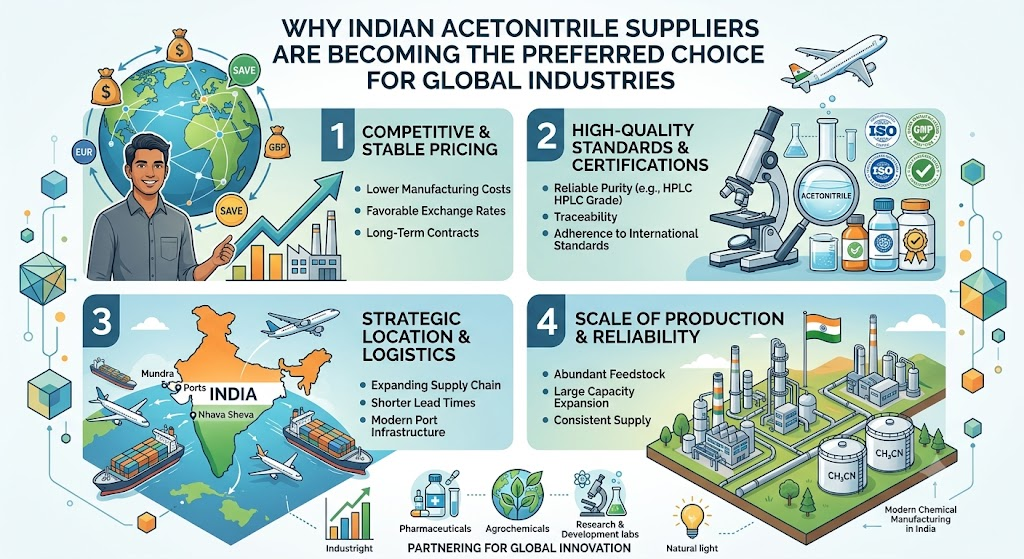
I think that the global chemical scene has been changed for good. For a long time, the world has relied on Western or concentrated East Asian regions as main hubs. However, these markets have major structural vulnerabilities. International buyers today are rethinking their risk models. Besides infrastructure upgrades, Acetonitrile Suppliers in India are not only becoming backup source but also primary source of industries highly regulated worldwide.
It is time to know why this change is happening, what is special about the market, and how you can enter the procurement market without going through the last horrors of chemical buying.
The Strategic Macro Shift: Why Global Eyes Are Turning to India
If you want to understand the reasons behind the trend you should make a worldwide view on chemical production. Acetonitrile, as a very specific polar aprotic solvent is not something one can produce in a very short time. It is mostly a co-product from the manufacture of acrylonitrile, which is linked mostly to the auto, plastic, and acrylic fiber industries.
The supply of acetonitrile can suffer from unexpected stoppages in any of these global industries leading to scarcity of the product at the global level. It is the most volatile product on the market.
Moving Past the “China Plus One” Cliche
Everybody is chatting about the “China Plus One” strategy like it is a new and magical business philosophy. I mean, really, in fact, we all know it has been somewhere on our standard lists for years now. Nevertheless, the intention is not only to avoid a single source or to get away from trade tariffs but also to find a country that has the size and the domestic consumption to be able to take global supply chain shocks without a big impact.
India’s local pharma sector is booming at a rate that the market size in 2030 is expected to be over $130 billion. Since Indian drug firms produce huge quantities of high-purity solvents for synthesis of APIs and routine HPLC testing, chem producers had no option but to do major capacity build-outs. These expansions mainly aimed at local market that are in the neighborhood. A strong and consistent pressure by local market has led to the development of specialized capacity of Indian suppliers of Acetonitrile matching the global standards in terms of volume, consistency, and purity.
Infrastructure Resilience and Regulatory Evolution
Logistics were always the weak spot when it came to buying from the Indian subcontinent slow ports, lots of paperwork, domestic supply chains that are not efficient.
But nowadays it is very different. Basically, similar zones for chemical industry such as Petroleum, Chemicals and Petrochemicals Investment Regions (PCPIR) located mainly in Gujarat and Andhra Pradesh have been made up to make everything more efficient. We’re now talking of integrated pipelines, separate power grids, and automated customs clearance procedures that greatly reduce lead times. Besides, these physical infrastructures combined with compliance systems at a world-class level allow an industry hub to operate with a very clear purpose, it minimizes costly delays that indirectly reduce a company’s profit margins.
Technical Purity and the High-Stakes World of Grades
In the world of chemicals, even a minimum difference in the content of a component can be the qjuantitative and qualitative distinction between successful production and batch failure. Several procurement managers usually buy solvents as if they were mere commodities. Seeing “99% pure”on a specification sheet, they conclude, “Great, it’s all the same, let’s buy the cheapest option.”
The Analytical Benchmark: HPLC and LC-MS Grades
PCR and LC-MS Grades: Molecular biology laboratories and quality control departments worldwide simply cannot imagine a mobile phase solvent used other than acetonitrile, the first choice of most labs for analysis and chromatographic separations. It is essential to have a solvent that has an absorbance at the UV range as low as possible, exhibits no baseline drift, and contains the minimum level of trace metal impurities.
If the purification method of your acetonitrile supplier is not perfect, you will have problems with the contamination of chromatographic columns and baselines will show fluctuations. In order to ensure that their reagent and gradient grades meet or even surpass the standards of the American Chemical Society (ACS), leading manufacturers in India have heavily invested in multi-stage fractional distillation columns and automated glass-lined packaging lines.
The Pharmaceutical Nexus: API Synthesis and Peptides
Peptide synthesis and therapy development have come closer resulting in a revolution in the pharmaceutical industry. They are closely linked with acetonitrile usage until the refinement stage. To be compatible with the required chemical reactions the acetonitrile must be extremely homogeneous and in no way must it interfere with the reaction or composition of other reagents.
They use high-tech analytical labs that are hybrid operations consisting of NABL certified testing and calibration labs and state-of-art equipment for Gas Chromatography (GC) and Mass Spectrometry (MS). The firms want to show that they guarantee not only the purity but also the batch-to-batch uniformity of the material supplied.
Vetting Your Supplier: A Practical, Actionable Sourcing Checklist
In case you intend to diversify and establish a partnership with an Indian supplier, you should not be merely convinced of the attractiveness of the brochure. It is necessary to apply a systematic and very aggressive vetting approach which will help you to single out from world-class suppliers base those that just trade and pretend to be main producers.
Concerned with Acetonitrile Suppliers India potential partners, you actively seek deep operational transparency by applying the following technical filters:
1. Raw Material Security and Feedstock Integration
At this stage, you need to ask a potential supplier quite directly: Where do you get your crude acetonitrile?
The supplier without a highly secure, long-term feedstock sourcing agreement is in fact a great risk. The strongest players have multi-year supply contracts with major global and domestic petrochemical operators or rely on backward-integrated manufacturing models that completely shield them from sudden raw material scarcity. If a supplier is reluctant to disclose how secure their raw material supply is, it is time for you to walk away.
2. Manufacturing Automation and Scale
Pick up a company which is in the vanguard of digital control technologies in the industry.
- DCS/PLC: Make sure that the production facility utilizes Distributed Control Systems to a large extent to monitor such variables as temperature, pressure, and flow rate in real time in order to eliminate human error and ensure consistent quality.
- Capacity: In this respect, it is essential to analyze the ratio between the firm’s overall capacity and its current load. Thus, it is not reasonable to sign an exclusive contract with a small plant which operates at almost maximal capacity (98%), which means that your products will have the lowest priority in the distribution chain.
3. Comprehensive Regulatory Documentation
Typically, an elite supplier would have the certificates prepared and at hand for a quick audit. This not only demonstrates compliance but also serves as insurance against any regulatory pitfalls that may arise.
An established club will typically have their members’ certifications on file, including certificates of analysis, safety data sheets in GHS format, and traceability back to each drum or ISO tank for pharmaceutical end-uses while adhering to ISO 9001: 2015 Quality Management, ISO 14001: 2015 Environment Management, and ISO 45001: 2018 Occupational Health Safety Management Systems.
The Price vs. Value Paradox in Chemical Procurement
For one thing, let’s make a promise to each other, yes, price matters.
The Hidden Financial Drainage of “Cheap” Solvents
The offer initially appearing as the lowest in cost will, in fact, hide, often a scary list of indirect costs, if you get your products from an unorganized, cut-rate supplier. The case example is a shipment coming with moisture content slightly above the specifications. Your technical personnel will have to spend extra processing time to run additional drying, and the trace impurities result in a remarkable drop in the yields of your reactions, thus raw materials have to be increased significantly to reach the set target output.
Smart Hedging and Contractual Flexibility
Top-notch global sourcing departments avoid simple spot buys, which are transactional at best. What they do is agree on long-term framework agreements whereby the interests of both parties are protected from extreme swings of the market.
Leading Indian chemical suppliers are very advanced when it comes to contract formulation. They provide a wide range of pricing schemes including indirect-materials indexed formula pricing, fixed-price contracts for guaranteed quarterly quantities, and safety stock-related solutions where they keep dedicated inventory reserves at nearby ports. Utilizing these strategic arrangements, you will be able to shield your business from sudden market shocks while at the same time securing uninterrupted supply of a high-purity source.
The Logistical Game: ISO Tanks vs. Drums
Once a supplier is verified and pricing is agreed upon, you face a major logistical decision that has a direct impact on your total cost of ownership: what way do you want your product packaged and shipped? Acetonitrile is a Class 3 flammable liquid, which means handling, storage, and transportation of the product must strictly adhere to safety protocols on an international level.
The Efficiency of Bulk ISO Tanks
Large-scale use of ISO tanks is the best option for industrial operations that are of a large scale. These tanks contain approximately 20, 000 to 26, 000 liters of material, thereby greatly reducing loading and unloading times.
In addition, thanks to ISO tanks, you can avoid waste of packaging associated with the need to dispose of a large number of used drums, steel or plastic. This is a vital issue of ecological security, which is why many companies are actively striving to reduce the negative impact of their operations on the environment. At the same time, you need to have the necessary equipment to store and transport the desired amount of liquid safely. Thus, the organization needs to acquire tanks for storing bulk liquids, closed-loop systems for unloading liquids, and vapor recovery systems.
The Flexibility of Standardized Drumming
However, if your manufacturing plan changes suddenly or if you have several small production plants, the use of containers made of high-density polyethylene (HDPE) or especially lined steel drums may be a better way. Drums are quite simple to move, store and can be used for different production lines without heavy capital investments for bulk tank farms.
While buying drums from Indian suppliers, make sure that they use strong, standardized palletization and heavy-duty shrink-wrapping to prevent shifting or leaking during the long ocean transit. It seems a small issue but I can assure you that the sight of an open shipping container at your warehouse with all the goods literally dumped all over is something you will never want to experience.
Looking to the Future: Sustainability and the Circular Economy
The global industrial sector will be facing unprecedented environmental regulations and carbon neutrality mandates days after today and into the future. Buyers will be auditing not only the purity and price but also the environmental footprint of the entire supply chain.
Seems to me that the chemical industry can no longer rely on a linear “take-make-dispose” model only.
The Rise of Eco-Vadis and Green Manufacturing
Apart from this government actions, India have driven by global compliance needs in making the producers go green and thus adopt greener chemical processes, get increasingly equipped with photovoltaic lighting installation on their distillation plants and very eco-friendly wastewater treatment plants that operate in the zero liquid discharge (ZLD) mode, along with actively competing for the most prestigious of the global sustainability rankings like EcoVadis. By collaborating with a manufacturer that embraces green manufacturing, you are not only deflecting your supply chain from getting caught and facing the environmental limits but also increasing the image of your brand in a global market that is more and more environmental conscious.
Solvent Recovery and Co-Development Opportunities
It is a new trend in B2B chemical partnerships that international buyers working together with Indian manufacturers to establish closed-loop recycling processes or to develop innovative methods for repurposing spent solvent streams. Couple this level of collaboration goes way beyond a simple vendor-buyer relationship; in fact, the transformation of your supplier into an integrated strategic partner is the one responsible for pushing long-term operational efficiency and substantial cost reductions for both organizations.
The Final Takeaway: De-Risking Your Supply Chain Today
Well, we have spent good time on it; however, there is no substitute for looking at the bottom line.
Industries at the global level can be extremely unforgiving and a single break in a supply chain may cause huge loss of your market share and operational momentum.Being exposed to a highly concentrated or region-specific sourcing model is a risk no smart procurement executive would ever take.
Combining cutting-edge technical expertise, large-scale expansion opportunities, a strong domestic market presence, and a relentless focus on international quality benchmarks is what makes Acetonitrile Suppliers India the preferred selection for thousands of leading-edge global producers.
There is no need to chase elusive emerging market opportunities and seek lower acquisition costs. It is essential to design a reliable sourcing base that is strategically diverse and has the agility and resilience to meet all challenges. Take a closer look at your solvent procurement strategy, analyze risk exposure, and establish long-term relationships with capable Indian manufacturers that will empower your domestic operations and global expansion for decades.