

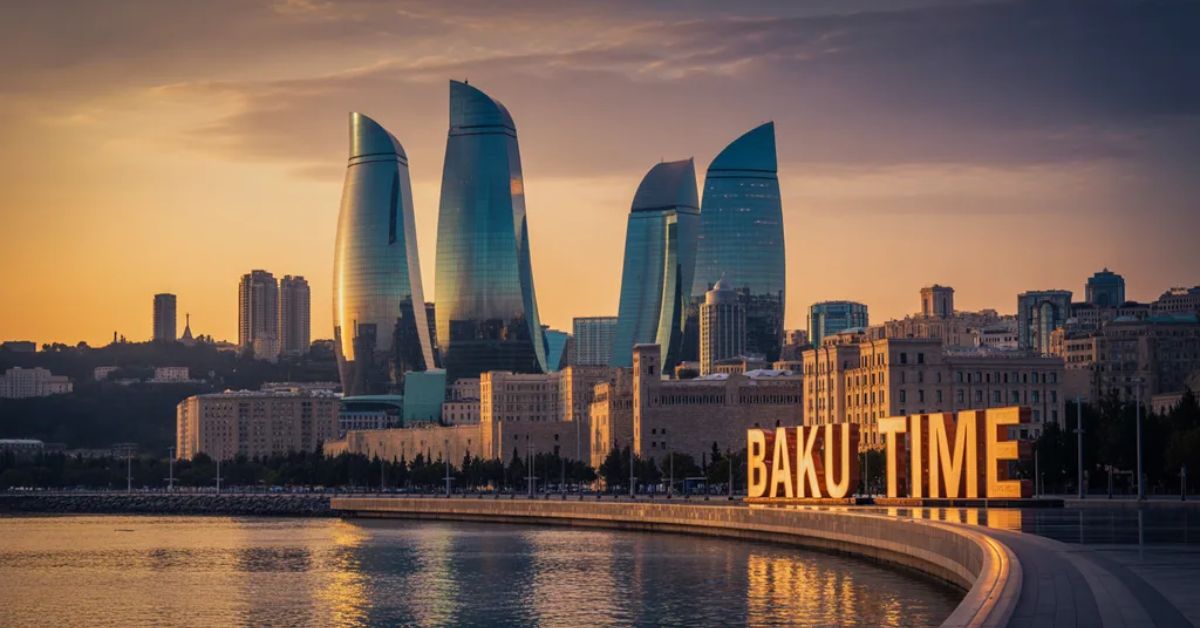
Imagine scheduling a critical business call with a partner in Baku, only to realize you missed the meeting by four hours — not because of a miscommunication, but simply because you did not understand Azerbaijan time zone. This situation happens to thousands of travelers, remote workers, and international businesses every year. Azerbaijan, a country positioned at the crossroads of Eastern Europe and Western Asia, operates on its own unique time standard that frequently confuses those unfamiliar with the region. Whether you are planning a trip to this ancient Silk Road city, conducting cross-border business, or simply trying to reach a friend living in Baku, understanding Azerbaijan Baku time is absolutely essential.
This comprehensive guide covers everything you need to know about the current local time in Baku, the Azerbaijan Time (AZT) zone, the UTC offset, daylight saving time history, and how Baku’s clock compares to major cities around the world. By the end of this article, you will have a complete understanding of Baku’s time system and how to use it accurately in your daily life.
Understanding the Azerbaijan Time Zone (AZT)
Azerbaijan observes Azerbaijan Time, officially abbreviated as AZT. This time zone places Baku at UTC+4, meaning the city is four hours ahead of Coordinated Universal Time (UTC). To put this in perspective, when it is noon (12:00 PM) in UTC, it is already 4:00 PM in Baku.
AZT is shared by the entire country of Azerbaijan, meaning there is no internal time variation within its borders. The country covers a relatively compact geographic area along the western shore of the Caspian Sea, which makes a single unified time zone both practical and logical. Baku, as the capital and largest city, serves as the cultural and commercial center from which this time standard is applied nationally.
It is worth noting that Azerbaijan’s UTC+4 position places it in the same time bracket as countries and territories such as Georgia, Mauritius, and the Russian region of Samara. This shared time bracket can be useful for businesses operating across these regions, as scheduling becomes considerably simpler when multiple parties operate on the same UTC offset.
Current Local Time in Baku: How to Calculate It
Knowing that Baku operates on UTC+4 makes calculating the current local time straightforward, regardless of where you are in the world. If you are based in London (GMT/UTC+0), simply add four hours to your current time to find out what time it is in Baku. A person in New York (UTC-5) during Eastern Standard Time would add nine hours to get Baku local time, while someone in Los Angeles (UTC-8) would add twelve hours.
For those in Dubai (UTC+4), the time is identical to Baku, which explains why business and trade ties between Azerbaijan and the UAE are relatively frictionless from a scheduling standpoint. Meanwhile, individuals in Moscow (UTC+3) are just one hour behind Baku, making coordination between Russia and Azerbaijan highly convenient.
In India (UTC+5:30), Baku is one and a half hours behind, so a 9:00 AM meeting in Mumbai corresponds to 7:30 AM in Baku. For those in Beijing or Singapore (UTC+8), Baku is four hours behind, turning a 4:00 PM local time in Asia into noon in Azerbaijan.
Understanding these offsets is especially critical for remote workers collaborating across time zones, international students, and multinational companies that have operations or clients in Azerbaijan.
Azerbaijan and Daylight Saving Time: A Brief History
One aspect of Baku time that often causes confusion is Azerbaijan’s relationship with Daylight Saving Time (DST). For many years, Azerbaijan did observe DST, shifting clocks forward by one hour during summer months to take advantage of longer daylight hours. During this period, the summer time zone was labeled AZST (Azerbaijan Summer Time), operating at UTC+5.
However, Azerbaijan officially abolished Daylight Saving Time in 2015. Since that decision, the country has remained permanently on UTC+4 throughout the entire year, with no seasonal clock changes. This means that unlike many European and North American countries, Baku does not “spring forward” in March or “fall back” in November. The time remains constant and predictable at UTC+4, year-round.
This decision was made partly to reduce energy consumption disruptions and partly to align with the preferences of the population, many of whom found the biannual clock changes disruptive. Azerbaijan joined a growing number of countries that have opted for a fixed, permanent time standard, which simplifies planning and reduces confusion for international contacts.
For travelers visiting from countries that still observe DST, this means that the time difference between Baku and your home country may shift by an hour depending on the season — not because Baku changes its clocks, but because your home country does.
Baku Time Compared to Major World Cities
To make international coordination easier, here is a detailed comparison of Baku time against major global cities, assuming standard (non-DST) time in all locations.
Baku vs. European Cities
London (UTC+0) is four hours behind Baku. Paris and Berlin (UTC+1) are three hours behind. Athens and Helsinki (UTC+2) are two hours behind. Moscow (UTC+3) is just one hour behind Baku, reinforcing the close temporal proximity between Russia and Azerbaijan.
Baku vs. American Cities
New York and Toronto (UTC-5 in winter) are nine hours behind Baku. Chicago (UTC-6) is ten hours behind. Denver (UTC-7) is eleven hours behind, and Los Angeles (UTC-8) is a full twelve hours behind. This large gap makes real-time communication between Azerbaijan and the west coast of North America particularly challenging, as business hours rarely overlap.
Baku vs. Asian Cities
Dubai and Tbilisi (UTC+4) share the same time as Baku. Karachi and New Delhi (UTC+5 and UTC+5:30 respectively) are one to one and a half hours ahead. Bangkok (UTC+7) is three hours ahead of Baku, while Beijing, Singapore, and Hong Kong (UTC+8) are four hours ahead. Tokyo (UTC+9) is five hours ahead of Baku.
Baku vs. Australian Cities
Sydney (UTC+10 or UTC+11 in summer) is six to seven hours ahead of Baku. For Australian companies doing business with Azerbaijan, early morning calls in Baku often correspond to afternoon or evening hours in Australia.
The Geography Behind Baku’s Time Zone Placement
Baku’s position on the globe provides a fascinating lens through which to understand why UTC+4 is a logical fit. The city sits at approximately 40.4° North latitude and 49.9° East longitude, placing it geographically in a band that spans Eastern Europe and Central Asia. At this longitude, true solar noon occurs close to 12:20 PM UTC, making UTC+4 a reasonable approximation of solar time for the region.
The Caspian Sea, which forms Azerbaijan’s eastern border, has long made Baku a hub for energy trade and maritime commerce. The city’s strategic position as a port city and its role as the center of the early global oil industry — Azerbaijan was one of the world’s first major oil producers in the 19th century — means that accurate timekeeping has always been commercially important. Synchronization with trading partners in Russia, Turkey, Iran, and beyond required a clear and stable time standard.
Today, Baku is a modern metropolis of approximately 2.3 million people in the city proper, with the greater metropolitan area housing over 3 million residents. As a rapidly developing city with a growing tech sector, tourism industry, and international business community, the accuracy and predictability of Azerbaijan time is more important than ever.
Practical Tips for Scheduling Across Baku Time Zones
For businesses, travelers, and remote workers, a few practical strategies can make managing Baku time significantly easier. First, always use a world clock application or a reliable online time zone converter and make sure Azerbaijan is listed as UTC+4 (not UTC+5, which was the DST offset no longer in use). Outdated tools sometimes still show the old summer time offset, leading to scheduling errors.
Second, remember that many of Azerbaijan’s immediate neighbors — Georgia, Armenia, and Russia’s Dagestan region — are in different time zones, so traveling across borders requires a clock adjustment even for short trips.
Third, when arranging international conference calls involving participants from Europe and Baku, the overlap window is narrow. European mornings (8:00–10:00 AM CET) correspond to Baku’s late morning (11:00 AM–1:00 PM AZT), providing a workable window. With North American participants, the overlap becomes nearly impossible during standard business hours unless one party starts very early or works late.
Finally, Azerbaijani business culture tends to value punctuality and formal scheduling, so arriving on time — and knowing what that time is — carries professional weight. When confirming meeting times with Azerbaijani contacts, it is best practice to specify both the local Baku time and the UTC offset explicitly to avoid any ambiguity.
Azerbaijan Time in the Context of Regional Geopolitics
Time zones are rarely just technical standards — they carry political and cultural significance. Azerbaijan’s decision to align with UTC+4 rather than UTC+3 (used by Turkey, with which Azerbaijan shares deep cultural and linguistic ties) or UTC+5 (used by parts of Central Asia) reflects a complex mix of geographic, economic, and historical factors.
During the Soviet era, Azerbaijan’s timekeeping was tied to Moscow’s central administration. Following independence in 1991, the country established its own national time standard, AZT, as part of a broader assertion of sovereignty. The elimination of DST in 2015 was another expression of national autonomy in setting time policy, aligned with a global trend toward simplifying time systems for the benefit of citizens and businesses alike.
Understanding this background adds depth to the seemingly simple question of “what time is it in Baku?” It is not merely a logistical matter, but a reflection of Azerbaijan’s identity as an independent, forward-looking nation positioning itself at the intersection of global commerce and cultural heritage.
Conclusion: Mastering Baku Time for Better Global Connections
Azerbaijan Baku time, operating permanently at UTC+4 under the Azerbaijan Time (AZT) standard, is one of the more stable and straightforward time zones in the Eurasian region. With no daylight saving adjustments since 2015, Baku offers a consistent reference point for international scheduling throughout the year. Whether you are four hours away in London, nine hours away in New York, or just one hour away in Moscow, understanding AZT gives you the precision needed to communicate, travel, and do business effectively with one of the South Caucasus region’s most dynamic cities.
As Baku continues to grow as a global hub for energy, tourism, and technology, the importance of knowing and respecting its local time will only increase. Keep UTC+4 in your world clock, and you will always be in sync with one of the world’s most historically rich and rapidly evolving cities.