

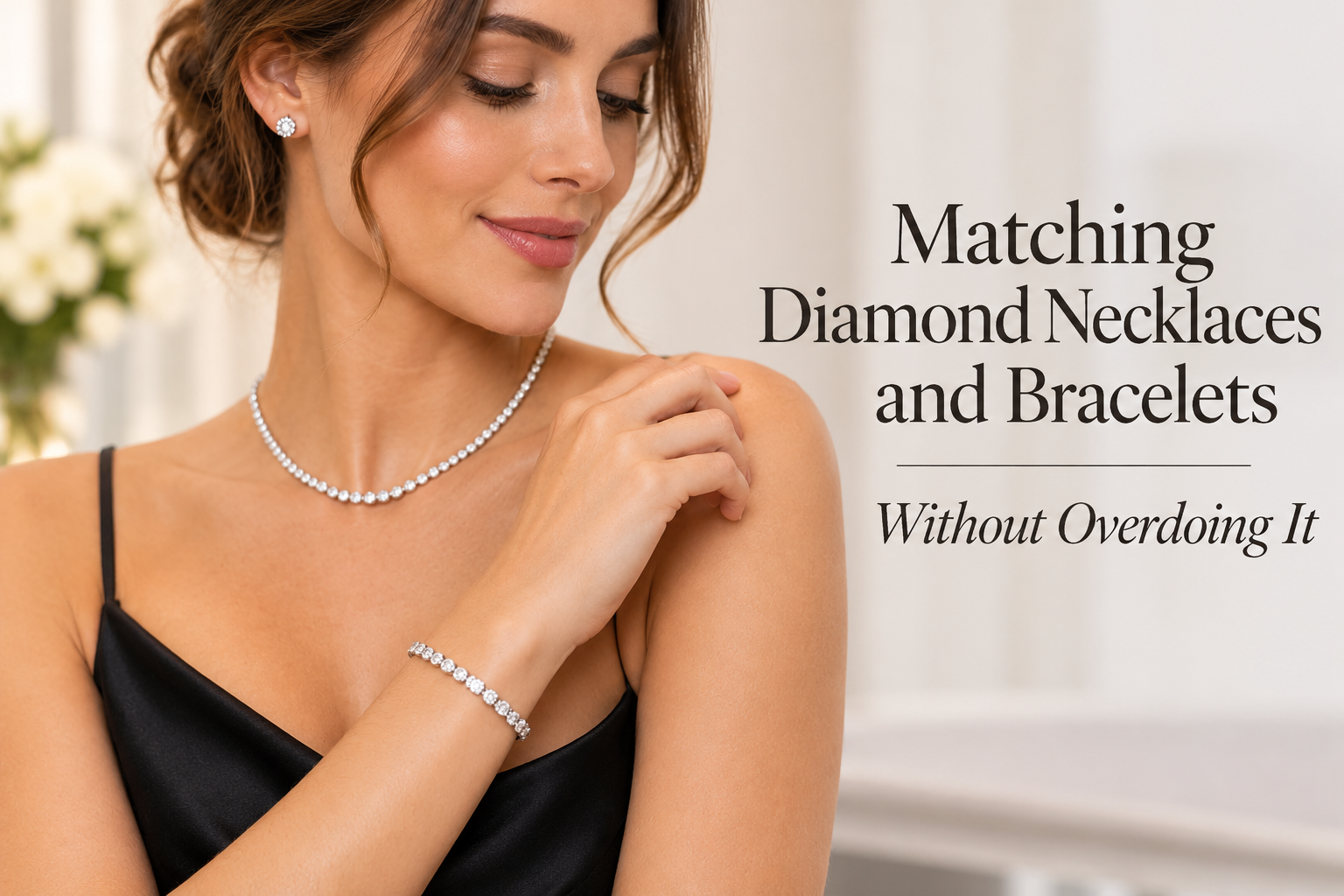
Buy a necklace on Monday and a bracelet on Friday, and by Saturday morning you’re wondering whether they’re supposed to look like a pair. Many of us have been there. The honest answer is that diamond necklaces and bracelets don’t need to match exactly, but they should agree on three basics: metal tone, scale and mood. Get those right, and the result looks considered rather than lifted straight from a shop display.
This guide explains how to pair the two, when it’s smarter to break the rules, and how to keep the look wearable on an ordinary Tuesday as well as at a wedding.

Do Diamond Pieces Really Need to Match?
No, they don’t. Matching helps when you want a polished, formal look, but pieces that simply share a metal colour and a similar level of sparkle usually look more natural. Think of it as a family resemblance rather than identical twins. The aim is for the necklace and bracelet to feel like they belong to the same person.
The Case for a Matched Set
A true matching set earns its place on certain days. If you are the bride, the mother of the groom, or anyone dressed for a black-tie event, wearing a necklace and bracelet from the same design family creates a deliberate look. Picture a solitaire pendant beside a bracelet of similar round stones. It’s tidy, it photographs well, and nobody has to guess what you were thinking.
The Case for Mixing
A slightly unfashionable view is trying to opt for a fully matched set as it is the riskier choice for everyday wear. Identical pieces can read like a uniform, and you lose the freedom to wear either one on its own. A related-but-different pairing gives you far more outfits from the same two pieces.
It’s kinder to the budget, too. Lab grown diamond bracelets are often priced below natural-stone equivalents of the same size, which makes it easier to build a collection gradually instead of buying one big set in a single go. However, if you want a cohesive look for a single event and don’t intend to wear the pieces separately afterwards, a matched set is still the best option.
How Do You Match Metals and Stone Shapes?
Start with metal. Keep both pieces in the same tone, white gold with white gold or yellow with yellow, then match the stone shapes loosely. Round stones pair happily with round stones, and cushion cuts echo each other. Getting those two things consistent does most of the work.
Metal Tones Come First
Metal is the first thing the eye registers, so if it’s wrong, nothing else rescues the look. White gold, platinum and other silver-toned pieces sit well together. Yellow gold with yellow gold works the same way. Rose gold is the awkward one, because it can clash with cooler metals unless you repeat it somewhere else in your outfit.
Purity deserves a glance as well. According to the UK’s Assay Offices, which hallmark precious metals, 18ct gold is 75 per cent pure gold and carries the number 750, while 9ct gold is 37.5 per cent. Two “yellow gold” pieces can look slightly different if one is 9ct and the other 18ct, because the higher-purity metal tends to be richer and warmer in colour.
Mixing metals on purpose is perfectly fine. The trick is repetition: a necklace with a white gold chain and yellow gold detail looks intentional beside a bracelet that repeats the same two tones.
Stone Shape and Size
Keep the shapes in the same family. Solitaire, halo and cluster diamond necklaces each suggest a different partner. A solitaire pendant likes a slim line of small stones on the wrist. A halo, which is busier, is happier beside something plainer. A cluster needs a bit of breathing space.
Scale matters as much as shape. As a rough rule, the larger the pendant, the finer the bracelet. A lab diamond bracelet made of small, evenly sized round stones is the ideal partner for almost any pendant, which is why it’s such a useful first purchase.
You might already own a ring that sets the tone. If you wear one of the lab grown diamond engagement rings in a round brilliant cut, repeating that shape on the wrist ties the whole look together without any fuss.

Adding a Splash of Colour
A gemstone-and-diamond pendant, such as an emerald with a diamond surround, can sit beside a plain diamond bracelet without competing. A ruby and diamond bracelet makes a strong partner for a simple diamond pendant. Let one coloured stone lead and let the diamonds support it.
When two colours compete for attention simultaneously, they create a visual imbalance.
How Long Should a Necklace Be Beside a Bracelet?
Choose the necklace first, then let the bracelet follow. A pendant on an 18-inch chain suits most necklines and sits comfortably alongside a bracelet of about 7 inches, because neither pulls focus from the other. Shorter chains want a lighter wrist, while longer chains leave room for a bolder bracelet.
Neckline and Chain Length
Jewellers use a few conventional lengths. A 16-inch chain sits at the base of the throat, an 18-inch chain falls at the collarbone, and 20 to 24 inches lands on the chest. These are trade conventions rather than fixed rules, and your height and build will shift them slightly.
A V-neck wants a pendant that follows the line of the V. A crew neck looks best with a shorter chain, so the stone sits above the fabric rather than disappearing behind it. Bare shoulders and strapless dresses suit 16 to 18 inches. A roll neck jumper? Go long and let the chain sit on top of the knit.
Wrist Fit and Weight
A bracelet should be snug enough that it can’t slide over your hand, yet loose enough to slip a finger underneath. Most adult bracelets are made at around 7 inches, but wrists vary a lot, so measure with a strip of paper rather than guessing.
Weight matters too. A heavier necklace asks for slightly more substance on the wrist, while a delicate chain suits a fine bracelet. Lab-grown diamond bracelets in a classic line style sit low and flat, so they snag less on knitwear than raised, claw-heavy designs. If you type all day, that’s worth knowing before you buy.
Layering Without the Clutter
Think in zones. Your neck and your wrist are two of them, and a ring or earrings add more. Allow one zone to dominate while keeping the others subdued.
If you want to layer two necklaces, space the lengths at least two inches apart so they don’t tangle into a single knot. Two is usually plenty. Three starts to look like you’re carrying a jewellery box around your neck.
What Works for Everyday Wear and Special Occasions?
Match the sparkle to the setting. For everyday wear, choose smaller stones in low, protected settings and a secure clasp. For weddings and evenings, you can go bolder with larger stones and more shine. The same pair can often do both jobs if you dial it up or down.
Everyday Wear
Diamond scores 10 on the Mohs scale, which makes it the hardest of all natural gemstones. Hardness isn’t the same as toughness, though. A sharp knock against a door frame can still chip a stone at its edge.
So here’s a point many buyers get backwards: the setting matters more than the carat weight. Diamond necklaces with a small, low-set solitaire cope with a commuter’s life far better than a large, tall stone on thin claws. The same logic applies at the wrist. A lab diamond bracelet with a box clasp and a safety catch is a sensible daily companion, whereas a bracelet with a simple hook is better saved for dinner.
Take both off for the gym, the garden and the washing-up. Jewellery lasts longer when it’s not asked to do chores.
Weddings, Evenings and Parties
Dress codes should guide the sparkle. A daytime wedding in a Cotswolds garden calls for restraint, so a slim pendant and a fine bracelet are enough. A black-tie dinner in London can take a fuller look, with a halo pendant beside a more substantial bracelet.
December parties are where people overdo it. A good test is the mirror: if you notice the jewellery before you notice yourself, take one piece off.

Gifting and Building Over Time
Buy the piece you’ll wear most often first, then add the partner later. That way you’re never stuck with a half-finished set you don’t love.
If a proposal is on the horizon, the ring usually sets the metal tone. Lab grown diamond engagement rings in white gold or platinum, for instance, point towards the same colour in later necklace and bracelet gifts. And if you don’t know someone’s taste well, choose one simple piece rather than a matching pair. A single understated pendant is hard to get wrong, and a lab diamond bracelet in a plain line style is almost as safe.
Frequently Asked Questions
Can I wear a necklace and bracelet in different metals?
Yes, as long as it’s deliberate. Repeat each metal at least twice across your jewellery, for example, a white gold necklace and bracelet with a yellow gold ring and watch. Accidental mixing looks careless, whereas planned mixing looks confident and surprisingly modern.
Can lab grown and natural diamond pieces be worn together?
Yes. Lab grown diamonds share the same chemical composition, crystal structure and hardness as natural ones. Lab grown diamond bracelets with a natural-stone pendant will look cohesive to most eyes, although it’s wise to keep each piece’s paperwork together for insurance and valuation.
Should my necklace match my engagement ring?
Not exactly. Share the metal and keep the stone shape in the same family. If your ring is one of the lab-grown diamond engagement rings in a round brilliant on white gold, a round-stone pendant in white gold is plenty. An identical halo design in every piece would be too much.
How many diamond pieces are too many?
A useful limit is three focal points at a time, say a necklace, a bracelet and a ring, with earrings kept to small studs. If every piece sparkles at full volume, none of them gets noticed. Pull one back, and the rest suddenly look deliberate.
Summing up
The best pairings share a metal and a mood rather than a mould. Pick one tone of gold or platinum, keep stone shapes in the same family, and let the larger piece lead while the smaller one supports. Check the chain length against your neckline and the bracelet against your wrist before worrying about anything else.
Mixing is often smarter than matching for daily life, and setting style matters more than stone size when you’re wearing pieces to work. Reserve the full matched set for the days that call for it. Diamond necklaces and bracelets look their best when they’re worn often, so choose the pair you’d reach for on a Tuesday, and let the grand occasions take care of themselves.