
Best Coding Kata Sites, Most programmers remember the moment they realized something uncomfortable: finishing a tutorial or a course did not make them a skilled developer. They could follow instructions, copy patterns, and build beginner projects — but put them in front of a real problem and the mind went blank. This gap between knowing syntax and being able to think algorithmically is one of the most frustrating experiences in a developer’s journey, and it is far more common than anyone talks about.
The answer to closing that gap has been around in martial arts and music for centuries: deliberate, repetitive practice through short, structured exercises. In the programming world, these exercises are called coding katas — a term borrowed from Japanese martial arts, where a “kata” is a choreographed pattern of movements practiced repeatedly until they become instinct. Coding katas are small, focused programming challenges designed to sharpen specific skills: problem-solving, pattern recognition, algorithmic thinking, and clean code habits.
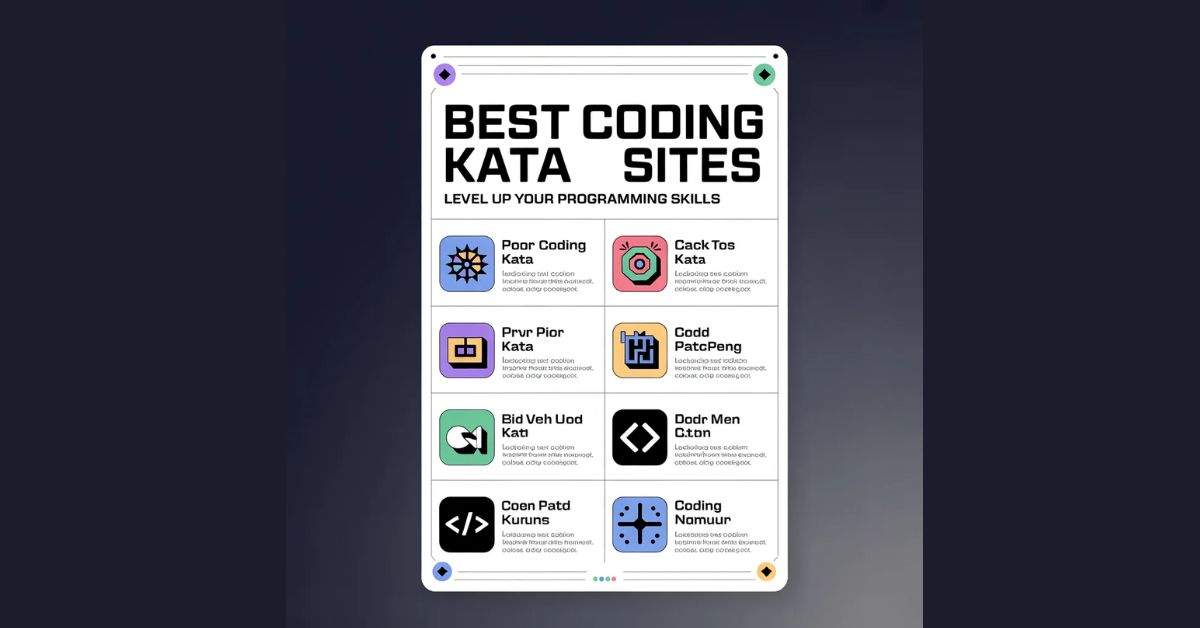
This article explores the Best Coding Kata Sites platforms available today, explains what makes each one valuable, and helps you understand how to choose the right one for your skill level and goals. Whether you are a self-taught developer preparing for technical interviews, a computer science student looking for extra practice, or an experienced engineer wanting to stay sharp, there is a platform built precisely for your needs.
What Makes a Great Coding Kata Platform
Before diving into specific platforms, it is worth understanding what separates a great coding kata site from a mediocre one. Not all challenge platforms are created equal, and using the wrong one at the wrong stage of your development can slow your progress rather than accelerate it.
The best platforms offer problems that are organized by difficulty and topic, so you can target weaknesses rather than wandering randomly through challenges. They provide immediate feedback, not just a pass/fail result but detailed explanations of why a solution works or fails. The strongest platforms also have community components — seeing how other developers solved the same problem is one of the most powerful learning tools available, often more educational than the problem itself.
Another critical factor is language support. A platform that only supports one or two languages limits your ability to practice in the language most relevant to your career. The top sites support anywhere from ten to over fifty programming languages. Finally, the best platforms align with real-world use cases, particularly technical interview preparation, since clearing coding interviews at competitive companies is one of the primary motivations for most developers seeking structured practice.
Codewars: Community-Driven Skill Building Through Ranked Challenges
Codewars is widely considered one of the best entry points into coding kata culture, and for good reason. The platform hosts hundreds of thousands of challenges called “katas,” ranked on a system borrowed directly from martial arts using a “kyu” and “dan” belt system. Beginners start at 8 kyu (the easiest level) and work their way up through increasingly difficult challenges toward 1 kyu and eventually “dan” ranks reserved for expert-level programmers.
What makes Codewars particularly valuable is its community-first philosophy. After solving a challenge, you are immediately shown how other developers approached the same problem. This feature alone transforms the learning experience. You might solve a problem in fifteen lines of code using nested loops, then discover that an experienced developer solved it in three lines using a higher-order function you had never considered. That moment of discovery accelerates growth in a way that no tutorial can replicate.
Codewars supports over fifty programming languages, making it one of the most versatile platforms available. According to data from developer surveys, JavaScript, Python, Ruby, and Java are consistently among the most practiced languages on the platform. The site is particularly popular among self-taught developers who appreciate the gamification elements — earning ranks, collecting honor points, and competing on leaderboards — which help maintain motivation over the long term. For anyone who finds traditional studying dry and unmotivating, Codewars offers a genuinely engaging alternative.
LeetCode: The Gold Standard for Technical Interview Preparation
If Codewars is the best platform for building general programming habits, LeetCode is the undisputed leader in one specific and high-stakes category: technical interview preparation for software engineering positions at top technology companies. The platform has become so dominant in this space that “grinding LeetCode” has entered developer culture as a common phrase referring to intensive interview preparation.
LeetCode hosts over three thousand problems categorized by topic — arrays, strings, dynamic programming, trees, graphs, binary search, and more — and by difficulty: easy, medium, and hard. The medium and hard categories in particular are closely aligned with the types of problems asked at companies like Google, Amazon, Meta, Apple, and Microsoft. According to multiple developer surveys and interview preparation communities, candidates who consistently practice LeetCode problems have significantly higher success rates in technical interviews than those who do not.
What distinguishes LeetCode beyond the problem library is its contest infrastructure and company-specific problem sets. Weekly and biweekly contests allow developers to practice under time pressure, which is essential preparation for actual interview conditions. The premium subscription unlocks questions tagged by specific companies, allowing candidates to focus preparation on the exact types of problems a target company tends to ask. For anyone serious about landing a position at a competitive tech firm in 2025, LeetCode is not optional — it is essential.
HackerRank: Structured Learning Paths for Multiple Disciplines
HackerRank occupies a unique position in the coding practice ecosystem because it extends far beyond algorithm challenges. While it does offer a strong library of competitive programming problems, its most distinctive strength is the breadth of disciplines it covers: SQL, regex, Linux shell scripting, mathematics, artificial intelligence, and even REST API challenges are all part of the platform’s curriculum.
This makes HackerRank particularly valuable for full-stack developers and backend engineers who need to demonstrate competence across multiple domains, not just algorithmic problem-solving. The platform organizes content into structured skill paths with certificates of completion, which some employers and recruiters recognize as a useful signal of competency. HackerRank also serves as an infrastructure layer for many companies’ own technical screening processes — meaning that when a candidate applies to a software role and receives a coding test, there is a significant chance that test is powered by HackerRank’s platform.
For developers who are newer to the field or who have specific skill gaps — say, weak SQL knowledge or limited experience with Unix commands — HackerRank’s domain-specific practice areas offer a focused, efficient way to address those gaps. The platform’s learning tracks guide users through increasingly complex challenges within a topic, building competence systematically rather than throwing problems at random.
Exercism: Mentorship-Enhanced Practice for Deeper Understanding
Exercism takes a fundamentally different approach to coding practice, one that prioritizes understanding over speed and mentorship over competition. The platform provides curated exercise tracks for over sixty programming languages, with each track containing dozens of progressively challenging problems specifically designed to teach idiomatic usage of that language.
What makes Exercism genuinely unique is its mentorship model. After submitting a solution, users can request feedback from volunteer human mentors — experienced developers who review submissions and provide personalized guidance. This is not automated feedback generated by a system; it is a real developer looking at your code and explaining not just whether it works, but whether it reflects good practices, readable structure, and the conventions of the language community.
This model makes Exercism especially powerful for developers learning a new language rather than simply sharpening existing skills. If you are a Python developer learning Go, or a JavaScript developer exploring Rust, Exercism offers a structured path through that language with human guidance that no automated platform can match. The platform is entirely free, running on open-source infrastructure and volunteer mentorship, which makes it one of the most accessible high-quality learning resources available to developers anywhere in the world.
Project Euler: Mathematical Problem Solving for Analytical Thinkers
Project Euler occupies a specialized but important niche in the coding practice landscape. The platform hosts over eight hundred mathematical and computational problems that require both programming ability and genuine mathematical reasoning. Problems range from number theory to combinatorics, from prime factorization to modular arithmetic, and they grow significantly more difficult as the numbers climb.
Project Euler is not for everyone. It is explicitly designed for developers and mathematicians who enjoy the intersection of computation and pure mathematics. Unlike platforms focused on data structures and algorithms relevant to interviews, Project Euler challenges strengthen a different and deeper capability: the ability to decompose complex mathematical problems into efficient computational solutions. Many of the higher-numbered problems cannot be brute-forced even with fast hardware — they require clever mathematical insight to become tractable.
For developers working in fields like data science, cryptography, financial modeling, or scientific computing, Project Euler offers practice that maps more closely to real work than interview-style algorithm challenges. Statistics from the platform show that the first hundred problems attract millions of solution attempts, while problems numbered above four hundred are solved by only a few thousand users globally — a testament to the depth of difficulty the platform eventually reaches.
Choosing the Right Platform for Your Goals and Skill Level
With so many strong options available, the question is not which platform is best in an absolute sense, but which is best for you right now. The answer depends almost entirely on your current skill level, your immediate goals, and the type of thinking you most need to develop.
If you are a beginner who wants to build confidence and general programming habits while staying engaged through gamification, Codewars is the natural starting point. Its community-first design and wide language support make it welcoming without being shallow. If your primary goal in the next three to six months is passing technical interviews at major companies, LeetCode should receive the majority of your practice time — no other platform prepares candidates more directly for that specific challenge.
If you are broadening your skill set across multiple technical domains, or if you are preparing for a role that requires competency in SQL, shell scripting, or APIs alongside algorithms, HackerRank’s multi-domain structure makes it the most comprehensive single platform. If you are learning a new programming language and want both structured exercises and human feedback, Exercism offers something no other platform does. And if mathematics and computational thinking are your passion, Project Euler will challenge you in ways that no interview-prep platform ever will.
The most effective developers do not limit themselves to a single platform. A common high-performance practice pattern in 2025 involves using LeetCode for interview preparation four to five days per week, Codewars for language-specific pattern building two to three days per week, and occasionally returning to Exercism when picking up a new language. This layered approach ensures that no single type of thinking dominates while allowing deliberate practice across the full range of skills a modern software engineer needs.
Building a Consistent Practice Habit That Actually Sticks
Understanding which platforms to use is only half the equation. The other half — and arguably the harder half — is building a consistent practice habit that survives the inevitable periods of frustration, busy schedules, and motivation dips. Research in deliberate practice theory, popularized by psychologist Anders Ericsson, consistently shows that frequency and consistency matter more than volume. Thirty minutes of focused daily practice outperforms a four-hour weekend session both for skill acquisition and long-term retention.
The most successful developers treat coding kata practice like athletes treat training: it is not something they do when they feel like it, it is something they do at a set time with a clear purpose. Starting each practice session with a specific goal — “today I am working on dynamic programming” or “today I am solving three medium-level string problems” — produces better outcomes than open-ended browsing through a platform’s problem library.
The coding kata sites discussed in this article collectively represent some of the best deliberate practice infrastructure available to developers in 2025. Each one offers a different lens through which to develop skill. Used thoughtfully and consistently, they do not just prepare you for interviews — they fundamentally change the way you think about problems, write code, and approach the craft of software development. That transformation, built one kata at a time, is what separates programmers who plateau from developers who keep growing throughout their careers.