

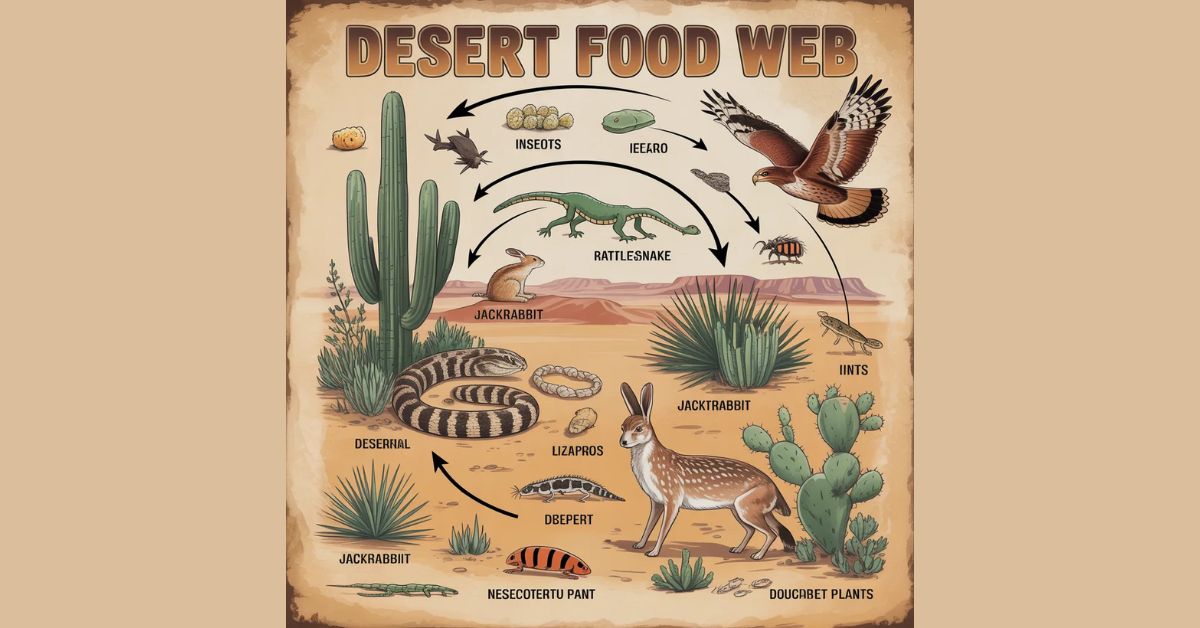
Desert Food Web, Imagine a landscape where temperatures swing from 50°C (122°F) during the day to near freezing at night, where rain may not fall for an entire year, and where the soil offers almost no shelter from a relentless sun. By every logical measure, deserts should be lifeless. Yet they are not. Covering approximately 33% of Earth’s total land surface, deserts are home to thousands of species of plants, animals, fungi, and microorganisms, all locked into a complex, interdependent network of feeding relationships known as the food web.
The desert food web is one of nature’s most extraordinary achievements — a tightly woven system in which energy flows from the sun down through producers, herbivores, carnivores, and decomposers with remarkable efficiency. Understanding this web reveals not just how life persists in extreme environments, but also why the removal of even a single species can unravel the entire system. This article explores the structure, players, and dynamics of the desert food web, from the microscopic crust on the soil’s surface to the apex predators that rule the night.
What Is a Food Web and Why Does It Matter in Deserts?
A food web is a map of feeding relationships within an ecosystem — a more realistic model than a simple food chain because it captures the fact that most organisms eat multiple things and are eaten by multiple predators. In a forest or ocean, food webs are wide and richly layered. In a desert, they are leaner, more precise, and under constant pressure from environmental stress.
What makes desert food webs particularly fascinating is their efficiency under scarcity. Because water and nutrients are so limited, energy must be transferred with minimal waste. Organisms have evolved extraordinary behavioral, physiological, and physical adaptations that allow them to extract maximum value from every meal, every drop of moisture, and every metabolic process. The result is a food web that appears sparse on the surface but is, in fact, deeply interconnected beneath it.
The Foundation: Desert Producers and Primary Production
Every food web begins with producers — organisms that convert sunlight into energy through photosynthesis. In deserts, primary producers face the dual challenge of intense solar radiation and extreme water scarcity. Yet they have evolved into some of the most specialized plants on Earth.
Cacti, found primarily in the Sonoran and Chihuahuan deserts of North America, store water in thick, fleshy stems and use CAM photosynthesis — a process in which they open their stomata only at night to minimize water loss. Shrubs like creosote dominate large stretches of desert and produce toxic resins that discourage herbivores, making them poor food for most animals but an important shade provider and soil anchor. Desert grasses and annual wildflowers capitalize on brief rainy seasons, completing their entire life cycle in weeks and leaving seeds that lie dormant for years until conditions are right.
Beneath the visible plants lies another critical producer system: biological soil crusts, communities of cyanobacteria, algae, mosses, and lichens that form a thin but vital living layer on desert soil. These crusts fix atmospheric nitrogen, reduce erosion, and provide nutrients that support plant growth. Research has shown that in some desert systems, biological soil crusts contribute more fixed nitrogen to the soil than all the desert plants combined — a staggering contribution that underpins the entire food web.
Primary Consumers: The Herbivores of the Desert
The animals that feed directly on desert plants — the primary consumers — have developed some of the most remarkable survival strategies in the animal kingdom. Their relationship with producers is not merely one of predation; it is a co-evolutionary dance in which plants and herbivores have shaped each other over millions of years.
Insects are the most abundant primary consumers in desert ecosystems. Beetles, grasshoppers, ants, and caterpillars feed on seeds, leaves, stems, and nectar. Harvester ants, in particular, are engineering marvels — they collect and store seeds in underground granaries, consuming some and inadvertently dispersing others, thus playing a dual role as consumers and seed dispersers. Studies in the Mojave Desert have found that harvester ant colonies can move up to 40 kilograms of seeds per hectare per year, directly influencing plant community composition.
Rodents such as kangaroo rats, gerbils, and desert mice are keystone herbivores across the world’s deserts. The kangaroo rat of North America is so well adapted to desert life that it never needs to drink water — it derives all its moisture from the metabolic breakdown of dry seeds. These small mammals are critical links in the food web, transferring energy from plant matter to the carnivores and raptors that hunt them.
Larger herbivores like the Arabian oryx, Bactrian camel, and desert tortoise occupy the upper tier of primary consumers. The desert tortoise can store water in its bladder and survive for up to a year without drinking. The Arabian oryx, once extinct in the wild, can detect rainfall from tens of kilometers away and navigate to fresh vegetation, making it a wide-ranging energy transporter across the desert landscape.
Secondary Consumers: Predators That Keep the Balance
Secondary consumers are the predators that feed on herbivores, and in desert ecosystems they are among the most skilled hunters on Earth. Competition for food is fierce, and the ability to locate, chase, ambush, or outwit prey in an open, resource-scarce environment has driven extraordinary evolutionary refinement.
Reptiles dominate many desert food webs as secondary consumers. The Gila monster of the American Southwest feeds on eggs, small mammals, and birds, surviving on as few as three to four large meals per year by storing fat in its tail. The monitor lizard of the Sahara and Arabian deserts is a formidable predator capable of taking down prey much larger than itself. Snakes, including sidewinders and king cobras, are specialists in ambush hunting, relying on heat-sensing organs to detect warm-blooded prey in total darkness.
Birds of prey are another vital layer of the secondary consumer tier. The burrowing owl, peregrine falcon, and secretary bird patrol desert skies and scrublands, hunting rodents, reptiles, and insects. Their presence helps regulate rodent populations, which, if left unchecked, would overconsume plant life and destabilize the lower tiers of the food web. Studies in the Kalahari have shown that the removal of raptor species leads to a measurable spike in small mammal populations and a corresponding decline in plant cover within just a few years.
Arachnids — scorpions and spiders — are often overlooked but critically important secondary consumers. The deathstalker scorpion of the Sahara hunts insects and small vertebrates at night, using venom to immobilize prey rapidly. Its role as a nocturnal predator places it at the intersection of multiple food chains.
Apex Predators: The Desert’s Top-Level Hunters
At the apex of the desert food web sit the top predators — animals with no natural enemies that regulate the populations of all species below them. Their influence, known as a trophic cascade, ripples downward through the entire food web.
The coyote is perhaps the most adaptable apex predator in North American deserts. Omnivorous and highly intelligent, it feeds on everything from rabbits and rodents to fruits and carrion. Its flexibility allows it to thrive even when prey populations fluctuate dramatically. The mountain lion inhabits desert mountain ranges and preys primarily on deer and bighorn sheep, exerting top-down pressure that prevents overgrazing of desert vegetation.
In the Sahara and Arabian deserts, the sand cat and the caracal serve as apex feline predators, hunting under the cover of night with extraordinary stealth. The African wild dog, now critically endangered, hunts in coordinated packs across semi-arid African savannas and deserts, with a hunting success rate of over 80% — the highest of any large land predator on Earth.
Decomposers and Detritivores: The Invisible Engine
No food web is complete without decomposers — the organisms that break down dead matter and return nutrients to the soil. In deserts, where organic material is scarce, decomposers are especially vital, yet they face the challenge of functioning in conditions that slow microbial activity.
Bacteria and fungi decompose dead plant material, animal carcasses, and waste, releasing nitrogen, phosphorus, and carbon back into the soil. Because desert soils are often alkaline and low in organic matter, this process is slower than in tropical systems, meaning nutrients cycle at a reduced rate. However, termites compensate for this by being extraordinarily efficient decomposers of woody and cellulose-rich plant matter. A single termite colony can process enormous quantities of dead wood, accelerating nutrient cycling in ways that profoundly benefit the entire food web above them.
Vultures and hyenas serve as macro-decomposers — scavengers that consume large carcasses and prevent the buildup of disease-carrying organic matter. The Lappet-faced vulture of the Sahara can strip a carcass to bare bone within hours, and its highly acidic stomach destroys pathogens that would be lethal to most other animals.
How Climate Change Is Threatening the Desert Food Web
The desert food web, already operating under extreme stress, is increasingly vulnerable to climate disruption. Global temperatures are rising at an average rate of 0.18°C per decade since 1981, and desert regions are warming even faster. This has cascading consequences throughout the food web.
Shifting rainfall patterns are altering plant communities, reducing the abundance of seeds and green vegetation available to primary consumers. As prey populations decline, secondary predators face food shortages and are forced to expand their ranges, increasing human-wildlife conflict. The phenological mismatch — a disruption in the timing of flowering, insect emergence, and animal breeding — is breaking the synchronization that desert food webs depend on.
Furthermore, invasive species are increasingly penetrating desert ecosystems. Invasive grasses like buffelgrass in the Sonoran Desert outcompete native plants and introduce fire regimes that native species are not adapted to, fundamentally restructuring the base of the food web and disrupting all the relationships that have evolved above it.
Conclusion: The Desert as a Model of Resilience
The desert food web is a testament to life’s relentless creativity. In an environment that seems designed to defeat survival, thousands of species have carved out precise ecological niches, forming relationships of predation, competition, mutualism, and decomposition that sustain the entire system. From the cyanobacteria fixing nitrogen in the soil crust to the apex predator scanning the dunes at midnight, every organism plays a role that cannot easily be replaced.
Understanding the desert food web matters beyond academic interest. Deserts are expanding globally — a process called desertification that affects over 2 billion people and threatens food security across Africa, Asia, and the Americas. By studying how desert ecosystems function, scientists and conservationists can develop strategies to protect, restore, and learn from one of Earth’s oldest and most resilient biomes. The desert does not just survive harsh conditions — it teaches us how to.