

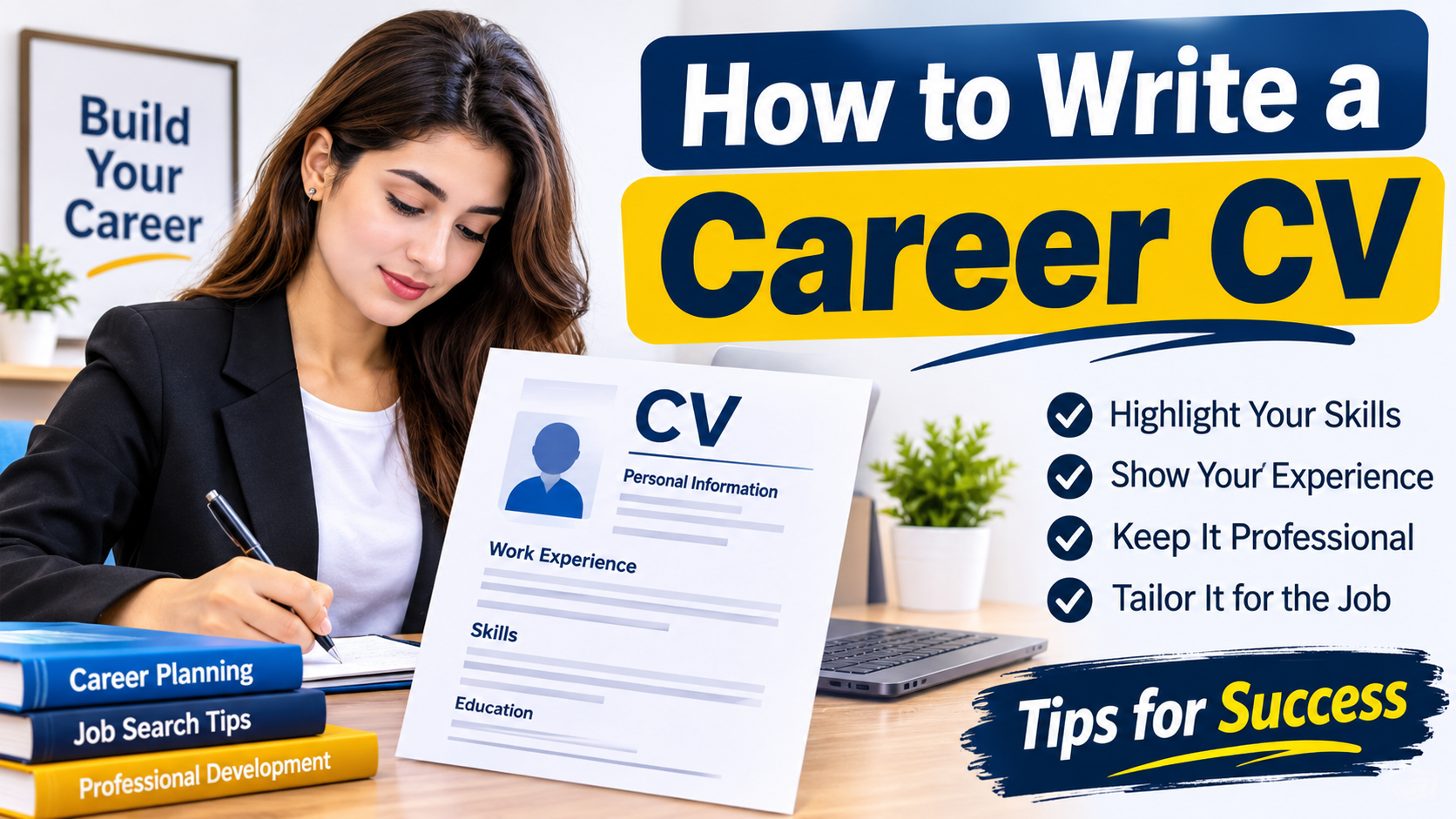
One of the most vital documents to acquire a job is a career CV. It communicates to employees who you are, you’re educational and skill set, your experience, and your area of interest. Having a strong CV could help you get an interview and improve your hiring prospects.
While for many a great CV is easy to create, others are unaware of how to make one. If you stick to several simple rules, you can write an easy-to-read, understandable, comprehensive, and professional CV.
In this article, you will learn in detail how to write a CV for your career path easily and effectively.
What is a Career CV?
A career CV is a document that presents a person’s complete career background. It’s more in-depth than a resume.
It includes:
Personal Information
Career objective
Education history
Work experience
Skills
Certifications
A CV is used to give a picture of how you’ve gotten to where you are now and whether you’re a good fit for a position.
Why a Good CV Is Important
CV is a major crucial factor in achieving success and getting a job. There are plenty of employers who receive numerous applications, so they opt for resumes that are of high quality.
A good CV:
Establishes a good impression at the start to get the job done
Clearly demonstrates abilities
Increases chances of interview
Highlights your achievements
Shows professionalism
Your CV might not get you the job, even if you are qualified for the field.
To create a well-structured CV that makes a strong overall impression, many individuals opt for CV Writing Service.
You can Add Your personal Information
Your CV should begin with the basic details such as:
Full name
Phone number
Email address
Location (optional)
Ensure contact details are accurate and robust so Employers can get in touch with you.
Focuses on Crafting a Career Objective
Write a Career Objective:
Your CV should begin with a short paragraph at the top stating your career objective. It boils down to your objectives and the type of employment you seek.
Example:
“Motivated person seeking a job to develop and apply the skills and expand in a professional environment.”
Have short sentences, no jargon, and a concise and focused message.
Enter Education Information
Then add your Educational record list degrees or qualifications, most recent to oldest.
Write:
Name of school or university
Degree or certificate
Year of completion
Students and fresh graduates: The following section is very important.
Requires Incorporating Work Experience
Include employment history (if applicable). List occupations in reverse chronological order (most recent chronologically at the top).
Include:
Job title
Company name
Duration
Key responsibilities
You can include internships and/or voluntary experience if you have none.
Promote and Publicize Your Skills
Skills are really valued in a CV. They show what you can do.
Examples of skills:
Communication skills
Computer skills
Teamwork
Problem-solving
Time management
Be sure to list only skills that are accurate and applicable to the job.
Include Certifications/Achievements
Enter any courses or training that you have acquired.
This can include:
Online courses
Workshops
Certificates
Awards
In this section, you must demonstrate that you wish to learn and get better.
Do not change the Format Simple
CVs need to be neatly presented and legible. Emphasize key words and include clear headings.
Formatting tips:
Use bullet points
Keep spacing balanced
Avoid fancy designs
Width: 95 | White Space: 95 | Orthodox Proportional: 60
Have a 1–2 page length
Employers are more likely to read through a simple CV quickly.
Tailor CV to the Particular Job
CVs should be based on the position for which you are applying. Adjust to the requirements of the work and the job.
Be sure to read the job description and incorporate skills and experience accordingly.
This will make you more desirable to be chosen.
To Prevent Frequent Mistakes, follow these Steps
There are lots of CV mistakes that people make! Avoid these:
Spacing errors (between words and end punctuation)
There are things that you don’t need to know.
Using complicated words
Failure to keep CV up to date
Writing long paragraphs
Always better to have a clean and simple CV.
Seek Professional Assistance if Necessary
Sometimes, composing a CV can be difficult. When this is the case, professional assistance may be beneficial.
Experienced experts are available to enhance the CV format, language, and presentation to make it more professional.
Here are Aome Simple Tips on How to Boost Your CV
Be concise and straightforward
Only attend to relevant Information
Emphasize success, not responsibility
Do not drag it out or get off topic.
Always confirm BEFORE you send!
Your CV should immediately convey that you are the most suitable candidate.
What are the Reasons Why you’d Need a Career CV?
A Career CV is more than a CV. This is your individual impression of employers.
It helps you:
Get job interviews
Based on their existing skill sets, they should start demonstrating their abilities and experience.
Construct a professional image
Stand out from other candidates
Your CV can pave the way for many career opportunities in your future.
Conclusion
It is quite easy to write a CV for a job if you take the appropriate steps. The important parts of a CV are as follows: it provides Information about you, is simple, short, and easy to follow.
If you can minimize errors and make sure your CV remains up-to-date, you can enhance your likelihood of obtaining a job. The first thing you can achieve by having a well-written CV is a strong marketing strategy that puts your career on the right track towards success and the fulfillment of your dreams.