

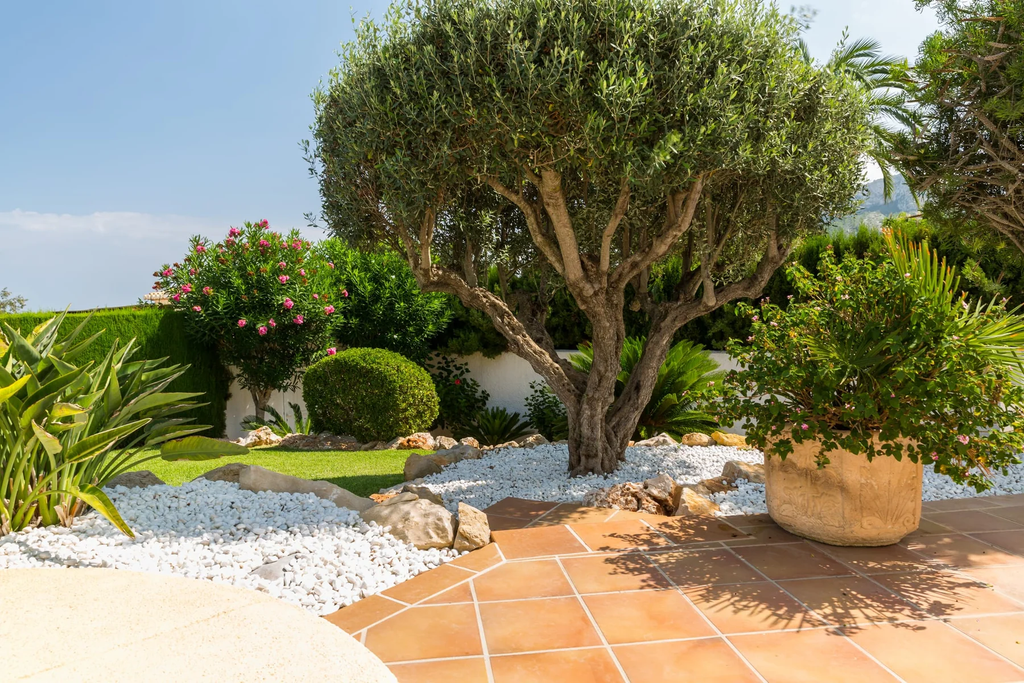
Few landscape plants carry as much history as the silvery-leaved evergreen found across the Mediterranean basin. An olive tree can anchor a patio, shade a courtyard, or add texture to a dry garden, and with the right conditions, it needs surprisingly little attention. Hardy in warm climates down to about 15°F, it thrives in full sun and well-drained soil, rewards patient growers with fruit, and can live for centuries. This guide explains how the plant grows and how to keep it healthy.
Origins and Characteristics
Olea europaea is native to the Mediterranean region and has been cultivated for thousands of years for its fruit, its oil, and its sculptural beauty. The gray-green leaves, gnarled trunk, and spreading canopy give the plant a timeless look that suits both traditional and modern landscapes, from gravel courtyards to formal entryways.
A mature olive tree keeps dense foliage throughout the year, which provides consistent greenery even in winter. This evergreen habit is one reason the plant remains popular for screening, shade, and focal points.
Fruiting Versus Fruitless Types
Many olives sold for landscaping are ornamental, and some produce small fruit. Fruitless varieties such as Wilsonii are especially popular for clean landscaping because they do not drop messy fruit on paving.
It also helps to avoid a common mix-up. Fragrant tea olive plants are smaller, aromatic, and flowering, while fruitless olives are larger, sculptural, and evergreen.
Choosing a fruitless olive tree makes sense near patios, pools, and walkways, where fallen fruit would stain surfaces and require constant cleanup.
Sun, Soil, and Space
Full sun and well-drained soil are the two most important requirements. The plant tolerates partial shade, but growth is strongest and foliage densest in bright light. Poor drainage is the most common cause of failure, so heavy clay should be amended with coarse material or avoided entirely. Planting on a gentle mound can also help water move away from the roots.
Size deserves attention before planting. Bush forms generally reach 6 to 15 feet tall and 4 to 8 feet wide, dwarf forms stay smaller, and a tall olive tree form needs even more room overhead and to the sides.
Watering and Maintenance
Newly planted specimens need regular watering until their roots establish. After that, mature plants require only occasional deep watering, especially during prolonged dry periods, and they thrive in dry climates.
Once established, an olive tree is highly drought tolerant, and overwatering is a more frequent problem than underwatering. Allow the soil to dry between deep soakings, and check moisture a few inches below the surface before adding more water.
Pruning should happen annually, ideally during a dry period. Remove dead, damaged, or crossing branches to encourage healthy airflow and new growth, and shape the canopy to suit the space. Thinning the center also lets sunlight reach inner branches.
Growing in Containers
Smaller forms adapt well to containers and patios, while larger tree forms prefer ground planting for long-term stability. In a pot, the principles stay the same: fast drainage, full sun, and restrained watering. Placing the container where it receives several hours of direct light each day keeps growth compact and foliage dense.
A young olive tree can live in a large container with generous drainage holes for several years, provided the potting mix drains quickly and the plant is repotted as the roots fill the space.
Hedges and Privacy Screens
Dwarf olive bushes and fragrant tea varieties form dense foliage, which makes them effective for hedges, borders, and privacy screens. Plant them at consistent spacing, trim each year lightly, and they will knit together into a living wall that tolerates heat and dry spells. Because the foliage stays dense year-round, these hedges also soften noise and block unwanted views in every season, which is difficult to achieve with deciduous plants.
Conclusion
Olive plants reward gardeners who respect their Mediterranean roots: full sun, fast drainage, and restrained watering. Nurseries such as Plant Clearance offer fruitless selections like Wilsonii that suit clean, low-maintenance landscapes. With those basics in place, the planting can stay attractive for decades.